Riemann surfaces
A Riemann surface is not the same object as a Riemann sphere, and the two are easy to confuse because both are 3D and both involve the word Riemann.
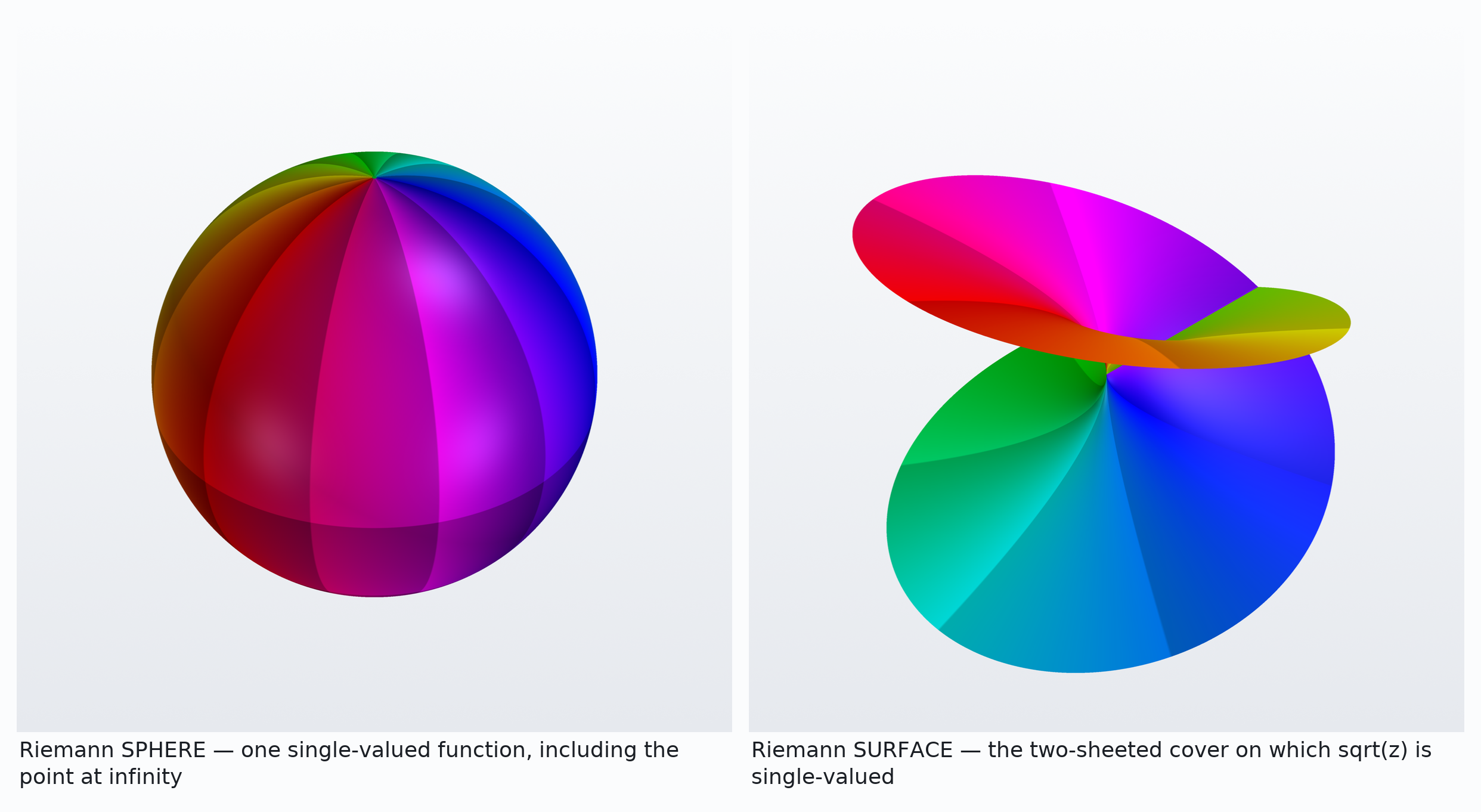
- The sphere compactifies the plane, so that a single-valued function can include the point at infinity. One function, one value per point, one sphere.
- The surface is the multi-sheeted cover on which a multivalued expression becomes
single-valued.
sqrt(z)has two values at every non-zero point; on its two-sheeted surface it has exactly one.
If the question is "what does this function do near infinity", you want the sphere (3D landscapes and the Riemann sphere). If the question is "how do the branches of this expression fit together", you want the surface.
Drawing one
import complexplorer as cp

cp.riemann_surface_pv("power", n=2)                  # sqrt(z): two sheets
cp.riemann_surface_pv("power", n=3)                  # cube root: three sheets
cp.riemann_surface_pv("log", turns=3, r_max=3.0)     # the logarithm's helicoid
cp.riemann_surface_pv("algebraic", p=[1, 0, -1])     # w^2 = P(z)
Three families are available:
power— then-th rootz^(1/n), withnsheets joined at a branch point of ordernat the origin.log— the logarithm, whose surface is an infinite helicoid;turnschooses how much of it to draw. Because the height grows with every turn, a taller surface wants a wider one:r_max=3.0keeps it from looking like a drinking straw.algebraic— curvesw² = P(z), withpgiving the polynomial's coefficients in descending order, so[1, 0, -1]isw² = z² − 1.
The rendering arguments are the same as everywhere else in the 3D API: resolution, cmap,
camera_position, window_size, interactive=False with filename to write an image, and
return_plotter=True to keep composing.
Reading one
The sheets are stacked in height and coloured by phase, so a branch point is where they meet. Walk
once around the branch point on the surface and you arrive on the next sheet, not back where you
started — which is the whole reason the surface exists. After n circuits of an order-n branch
point you return to the sheet you began on.
The branch cut you see in a flat portrait of sqrt(z) — the line where the colour jumps
discontinuously — is the seam where the flat picture was forced to choose one sheet. On the surface
the discontinuity is gone; only the choice of where to cut was ever arbitrary.
Next
- The gallery shows the branch-cut presets (
sqrt,cbrt,log) as flat portraits, which is the contrast that makes the surface worth the trouble.