About
A project by Igor Kuvychko (LinkedIn): a desktop display that is enjoyable as an object and useful as an instrument, and an excuse to understand two kinds of cold-cathode tube properly.
Sources
- John and Robin Acton, Dekatron – The Story of an Invention, Resurrection 61, Computer Conservation Society.
- The National Museum of Computing, The Harwell Dekatron / WITCH.
- Ericsson 1954 Dekatron catalogue, transcribed on electricstuff.co.uk.
- Industrial Alchemy, Dekatron glow-transfer counting tubes: dekatron types, speeds and fill gases.
- Threeneurons' Dekatron Shield, the reference A101 design for this project's operating values and circuit topology.
- Datasheets and design references are listed in the repository's references.
Acknowledgements
The dekatron controller and power-supply boards were made by PCBWay, who sponsored their fabrication. Ordering was easy and smooth, and their website gives a lot of information along the way, including a step-by-step walk-through of how a board is made. The boards arrived a week after the order, sealed with a desiccant pack and clearly labelled, with clean milled edges (no break-away tab remnants to file).
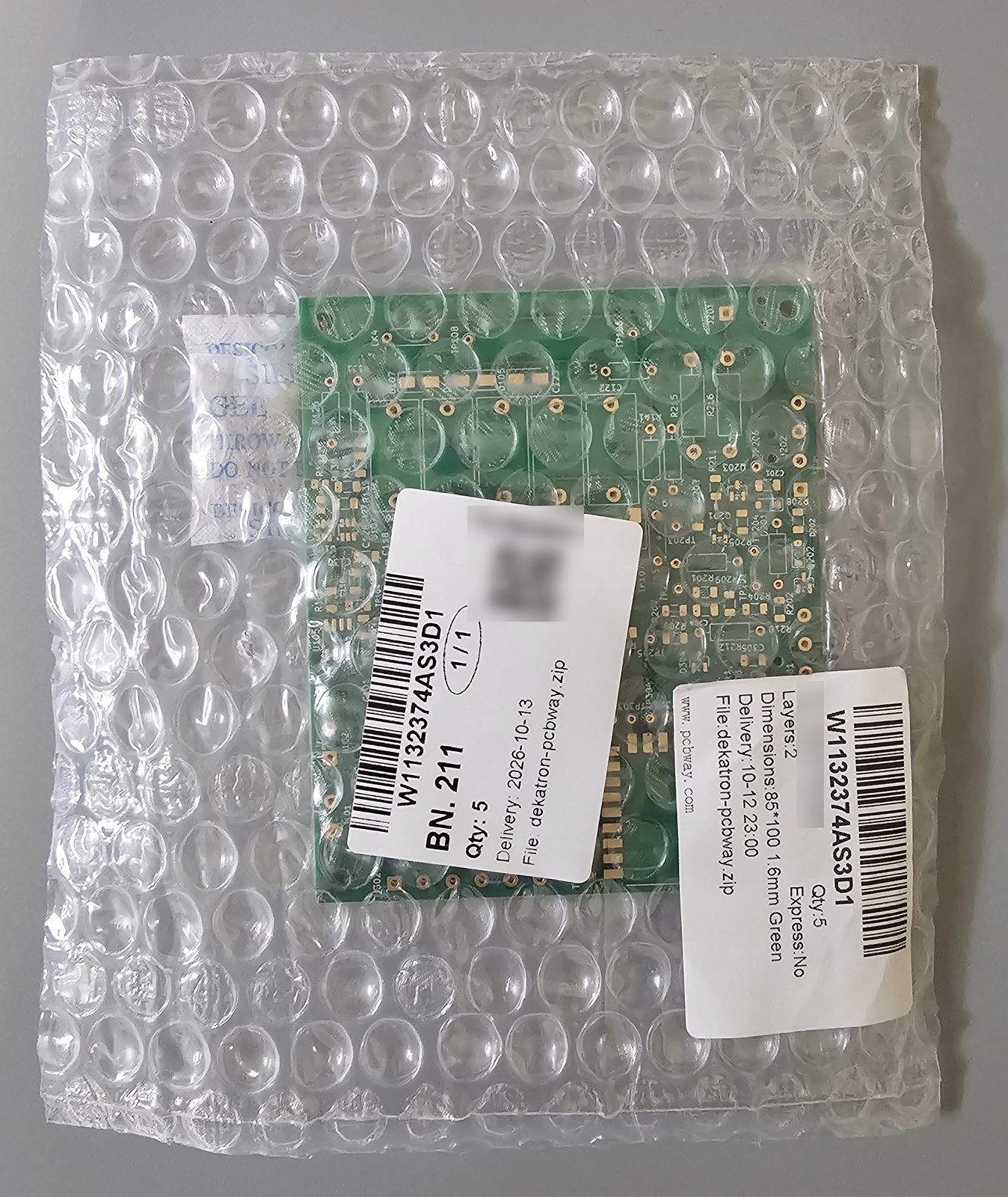
As delivered, October 2026 (QR code blurred).
Licences
- Text, diagrams, photographs and hardware: CERN-OHL-P v2.
- Code (firmware, tools, and this site's JavaScript): MIT.
Third-party datasheets, historical documents and images keep their own rights; this site links to them rather than copying them.