Universal Nixie Display
Six IN-14 Nixie tubes in a row, one A101 dekatron and a small touchscreen, in a desktop enclosure. It is a clock, a timer and a toy on its own, and a numeric display for a computer or an experiment over USB.
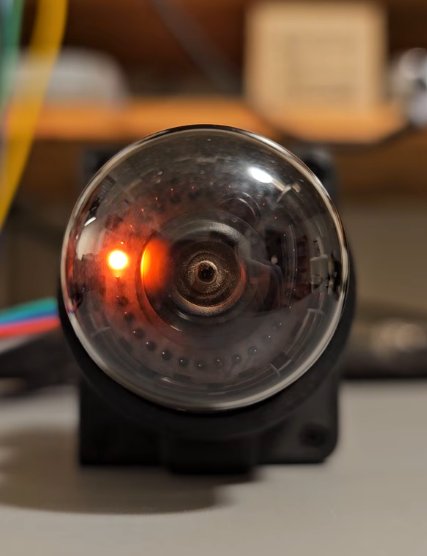
The project's A101 dekatron stepping on the bench, from a 400 V supply (watch on YouTube, recorded 2026-10-19). How it works, with a ring you can step yourself: How a dekatron counts.
How can a glow in a gas-filled tube display a number, or remember and count one?
The two kinds of tube answer that question in opposite ways. A Nixie is stateless: it lights whichever numeral its driver selects, and forgets it the moment the drive changes. A dekatron is stateful: a spot of glow sits on one of ten cathodes, and pulses move it one place round the ring, forwards or backwards. The position of the glow is the number, and the tube holds it by itself between pulses. One tube shows a number; the other remembers one.
High voltage
The tubes run at 170-450 V DC, which can cause serious injury or death. Anything you build or try from this project is at your own risk: read the safety notes first.
Two ways in
Explore the display. What the finished instrument does, its controls and its modes, as they become real.
Understand the tubes. Start with the dekatron: an interactive ring you can step through, why only one glow can exist, how it moves, the bench circuit that drives it, how fast it can count, why the tube is a memory, and a short history. Then the Nixie.
Status
The display is under construction. The dekatron controller and power-supply boards are made (fabrication sponsored by PCBWay) and now being brought up, and the A101 dekatron has been bench-tested: it strikes, holds its glow and steps reliably in both directions (the video above). Since 2026-10-25 it also runs from the first assembled board, which steps it at up to 200 steps/s (watch on YouTube), and since 2026-10-26 its HV supply holds its setpoint with the tube lit. The Nixie side comes next. See Build and investigate.