Experiments
Each experiment changes one controlled factor. Each records its configuration, code commit,
package versions and output hashes in a manifest under experiments/<id>/, and can be rerun
from the repository with one command. The figures below are the published evidence.
E001: the comparison atlas
Eleven solids and five recipes, under one fixed display. Every recipe passes the exact checks:
- local orders;
- duality;
- symmetry of the relief;
- rotation.
What differs is degree, the shape of the field, and readability.
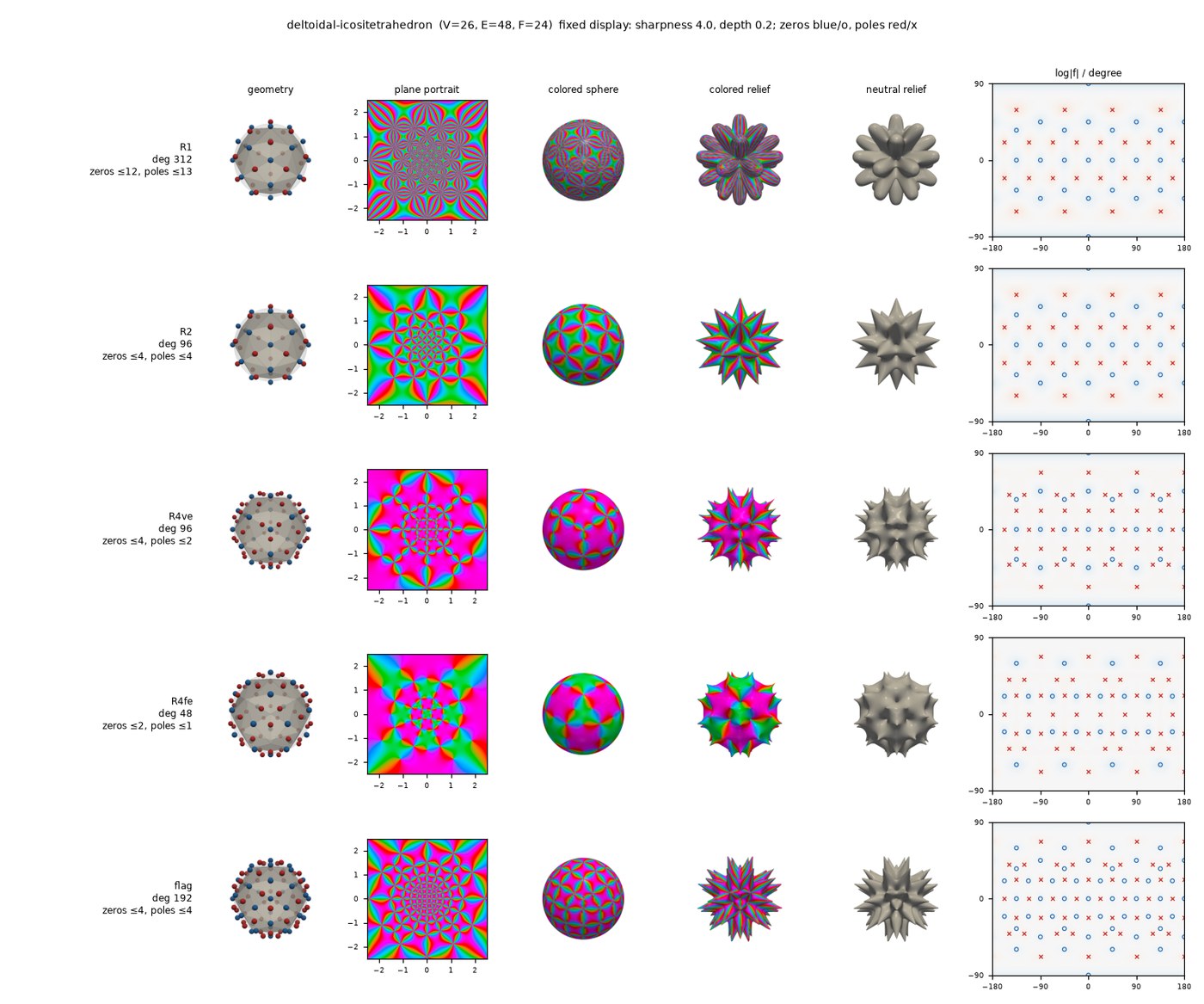
The deltoidal icositetrahedron. R1 and R2 have nearly identical per-degree maps (right). The R1 relief looks rounded only because its local orders are higher under the same display.
E002: when a face or edge shrinks to nothing
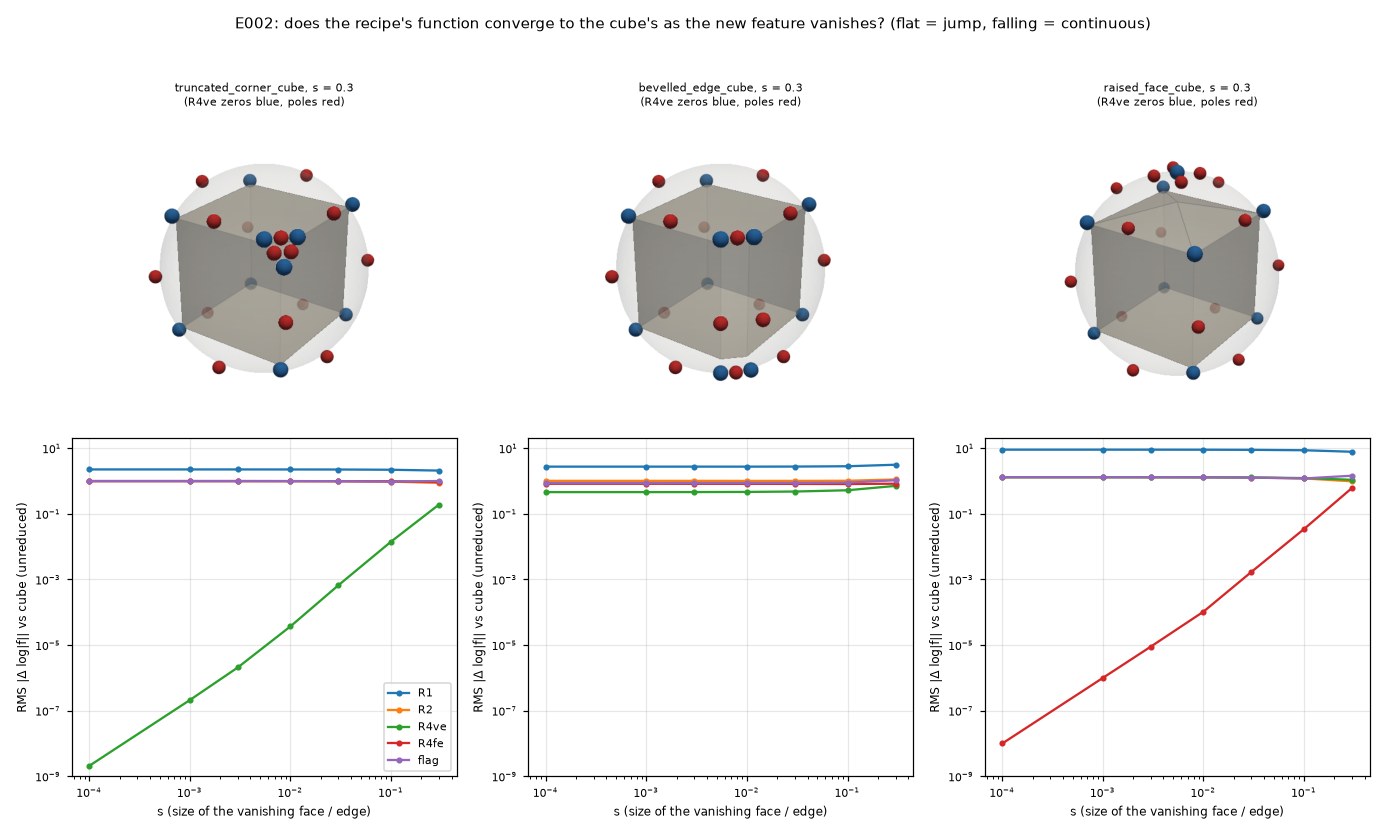
Three transitions were tested on the cube: a corner cut away, an edge bevelled, and a flat pyramid raised on a face.
- R4ve is continuous as a corner truncation vanishes, and R4fe as a raised face flattens. Both converge as the square of the feature size.
- The other recipes jump to a different limit. The jumps were tested on the cube; for vertex truncation, R2's jump is derived in general.
E003: deformation and placement
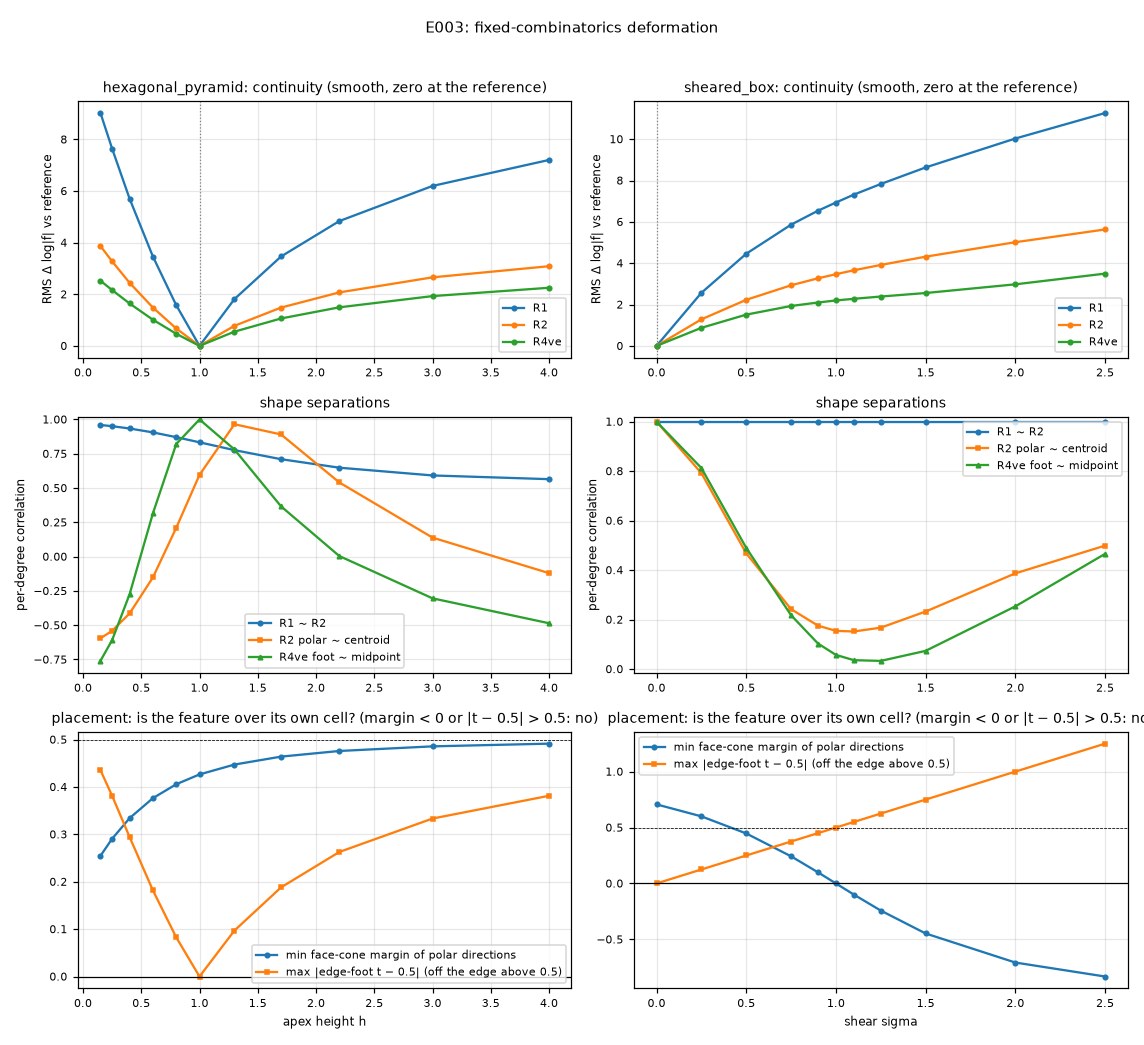
The pyramid's height varies, and so does a box's shear, with the combinatorics fixed throughout.
- Every recipe changes continuously.
- On the sheared box, the polar placement puts a face's pole outside its own face from shear 1 onwards. A centroid placement never leaves the face, but it breaks exact duality.
E004: what the display does
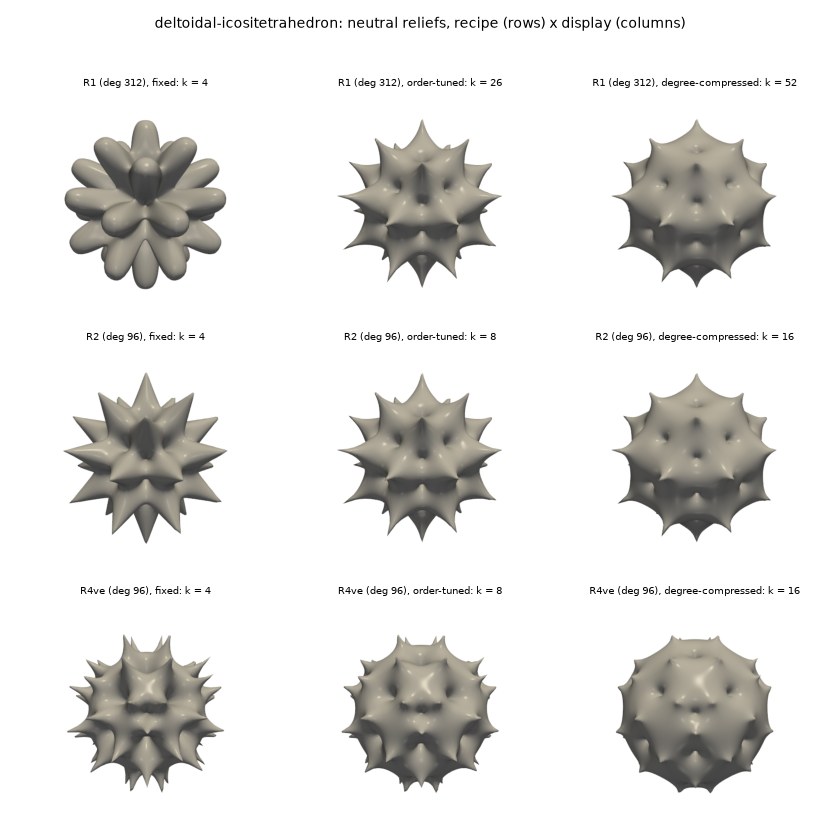
The same functions are shown under three relief displays. Most of the visible difference between R1 and R2 is display: tuning the sharpness to each recipe's highest order largely removes it. The difference between R2 and R4 remains under every display.
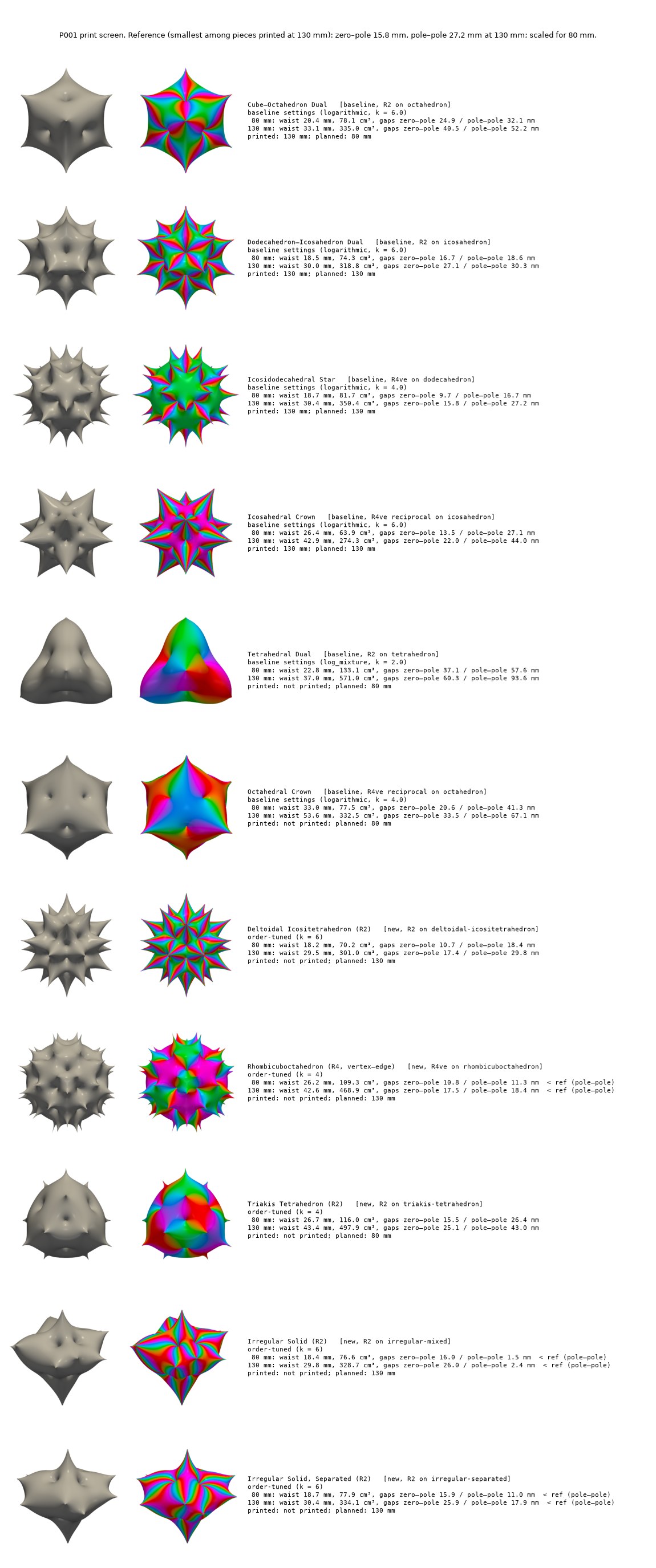
For printing: P001 and P002
These two runs screen the catalog for printability. P001 measures waist, volume and the closest feature gaps at 80 and 130 mm. P002 proposes cut planes for two-part prints.