Polyhedra as complex functions
These Riemann relief maps turn complex functions into objects you can hold: poles become spikes, and zeros become pits.
A convex polyhedron is a finite, rigid object. A rational function on the Riemann sphere is determined, up to a nonzero constant factor, by finitely many points, its zeros and its poles, each with its multiplicity. This project translates one into the other: it places zeros and poles where a polyhedron's vertices, faces and edges point, and studies the function that results.
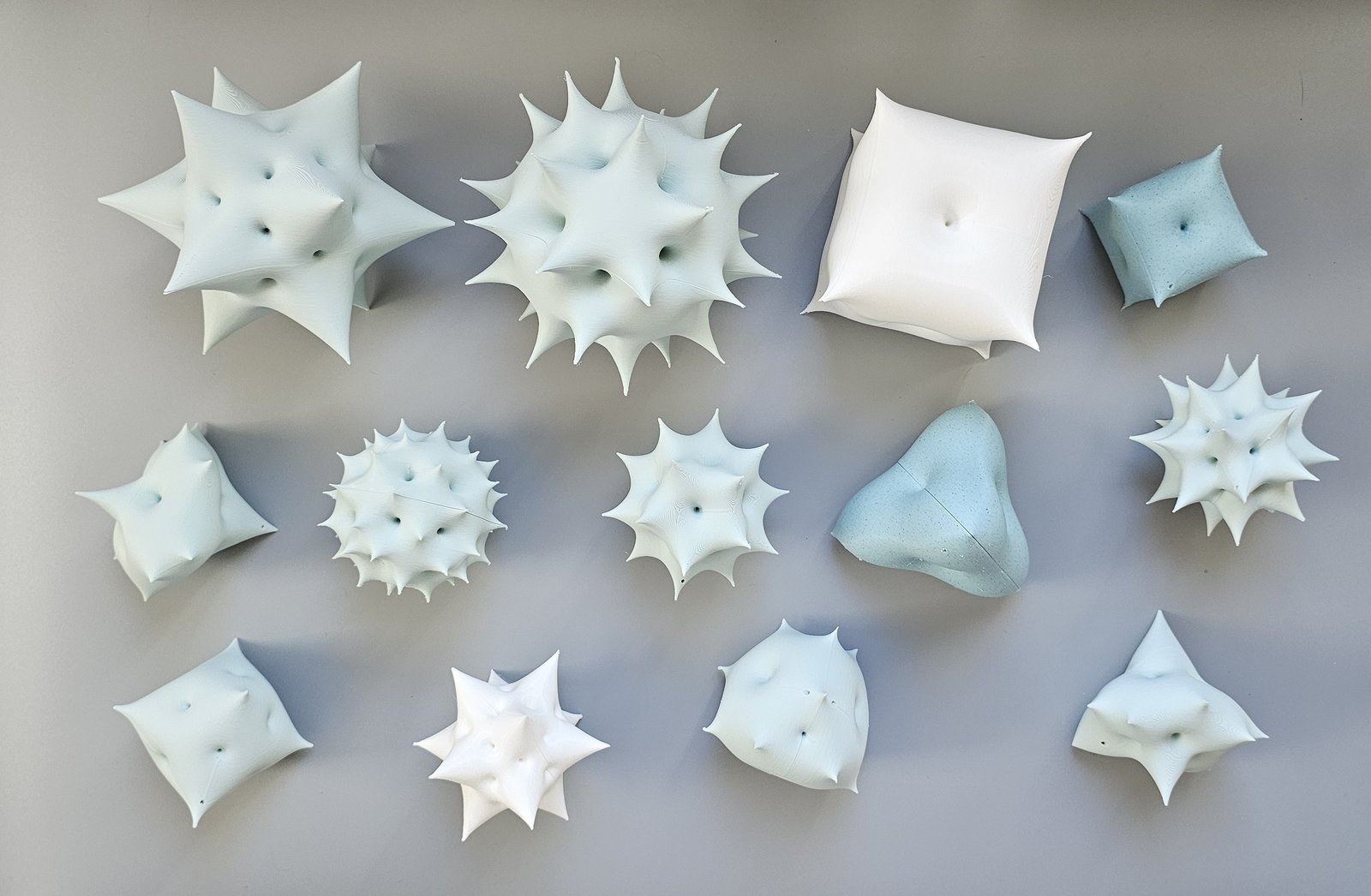
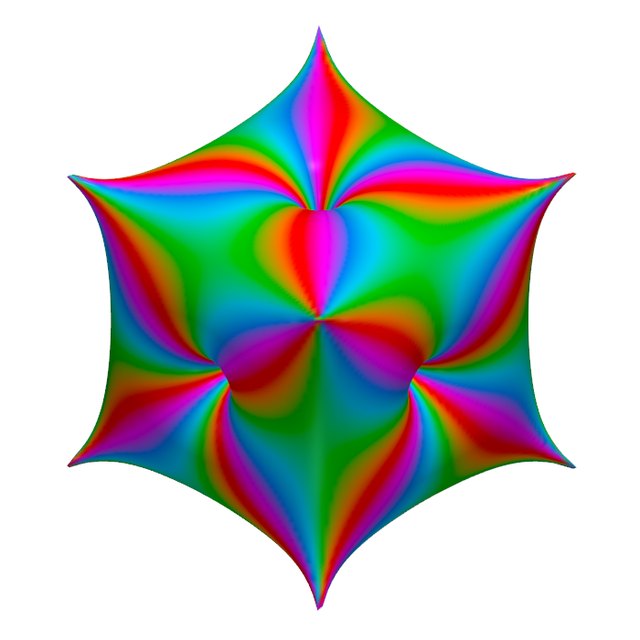
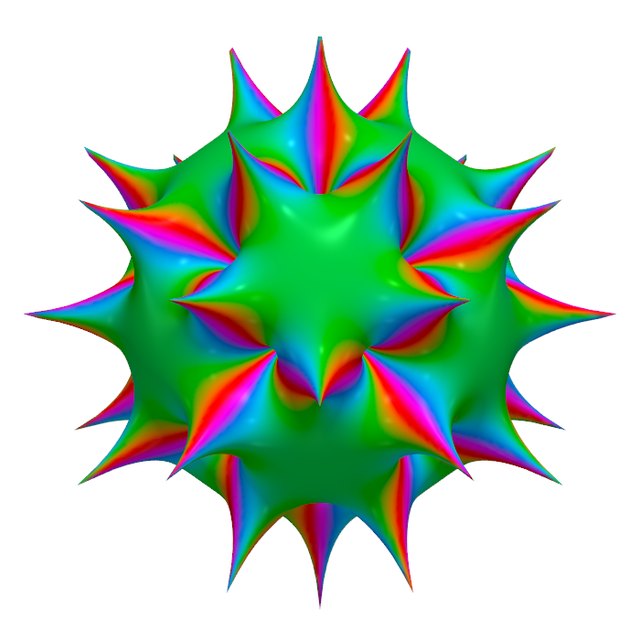
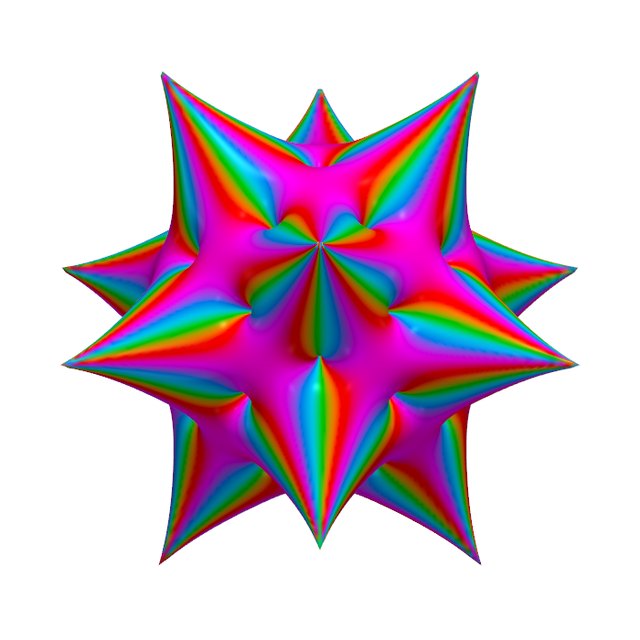
The function's modulus pushes the sphere out into a relief: poles become spikes and zeros become pits. On screen, the color is the function's phase:
Two ways in
The objects. Start with the things themselves: what each one is, how it prints, and where to get the files.
The question. Start with the mathematics: what it means to turn a polyhedron into a function, which recipes do it well, and where they fail.
New to complex numbers? Start here: a gentle introduction to the Riemann sphere, stereographic projection and the reliefs, with figures you can turn and drag.
Status
The research (Phase 1) is complete, and the exhibition is printed: twelve designs, each with print files linked from its page and gathered in one Printables collection.